The Hexachord Harmonizer
Alert: The system outlined below is one I no longer use. It's what I gave students 10 years ago to help them create their own arrangements. What students get now is a much more refined version, but I thought I'd include the outdated one to give an idea of the kinds of things I get into with some of my students.
The Hexachord Harmonizer is a sort of "paint by the numbers" approach to harmonizing melodies I developed for some of my steel guitar students. With the harmonizer, your musical palette consists of six triads for the key you are in, and your canvas is the song's melody, that is, the notes of the major scale for the key you're in. The system describes a method for selecting one or more of these triads to harmonize the melody notes of your song.
The harmonizer works on almost any standard sixth-type tuning and is a great remedy for players who complain about being tied to sheet music. The system not only allows you to create correctly harmonized arrangements but broadens your musical palette by giving you different ways to color a melody.
Not For Everyone!
The harmonizer is not for everyone, and I don't insist that students adopt it. For those with an interest in basic music theory, it can be a very quick way to create your own arrangements.
What You Need to Know

To use the harmonizer, some knowledge of music theory is required, including the following:
- Keys and Scale Degrees – You should know the common major keys (C, D, E, F, G, A, Bb, Eb, and Ab) and know how to spell (or at least play) the notes of those scales, also called scale degrees. So if you're in the key of A and the melody is an F#, you should know that F# is the 6th note or 6th degree of the A major scale.
- Chord Function – This sounds harder than it is. If you're in the key of D, for example, you should know that a D chord is the tonic, that a G chord is the subdominant, and that an A or A7 chord is the dominant for this key.
If you don't quite have a handle on the above, there are some excellent websites that walk you through all the basics you'll need. In just a few weeks, you could be ready to start creating your own arrangements. Try the following websites:
You should also check out the newly posted music theory primers on my download page.
The Hexachord Harmonizer Building Blocks
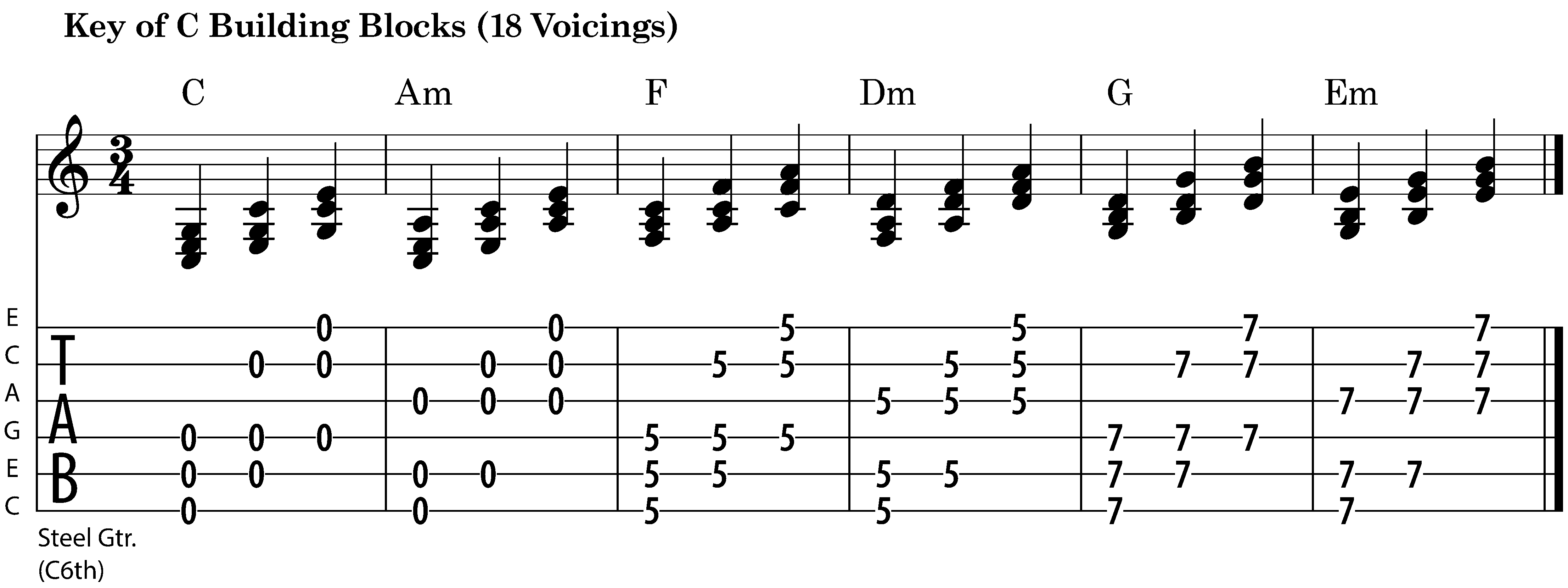
The chart below shows the six chords used by the harmonizer to build arrangements for the key of C. There are 3 major chords and 3 minor chords, and each chord appears in 3 inversions for a total of 18 voicings. As you can see from the chart, the 18 chords form an easily learned pattern. The chords at the 5th and 7th frets are just the chords in the open position moved up. These building blocks include:
- C major triads (Tonic)—All 3 inversions in the open position.
- A minor triads—All 3 inversions in the open position.
- F major triads (Subdominant)—All 3 inversions at the 5th fret.
- D minor triads—All 3 inversions at the 5th fret.
- G major triads (Dominant)—All 3 inversions at the 7th fret.
- E minor triads—All 3 inversions at the 7th fret.
A Bird's Eye View
The Hexachord Harmonizer is a method that organizes the above harmonies by melody note and chord function. What this means is that if you know the scale degree of your melody note and its accompanying chord, the harmonizer will suggest one or more chords that work in the given context. By repeating the process for each melody note, you can quickly build your arrangement.
Students who have opted to use the harmonizer take a basic lead sheet—one tune per week on average—and use the harmonizer to create an entire arrangement in either 2- or 3-part harmony. All you need is a one-page reference for 3-part harmony and another reference for 2-part harmony. The references are accompanied by a page of musical "swatches" or real live examples of the harmonizations in a real musical setting.
Full 3-part arrangements are always available using the method, but often involves large skips up and down the fretboard. By combining 2- and 3-part harmony you can find positions on your fretboard that are both convenient and flow well together.
Sample Harmonization
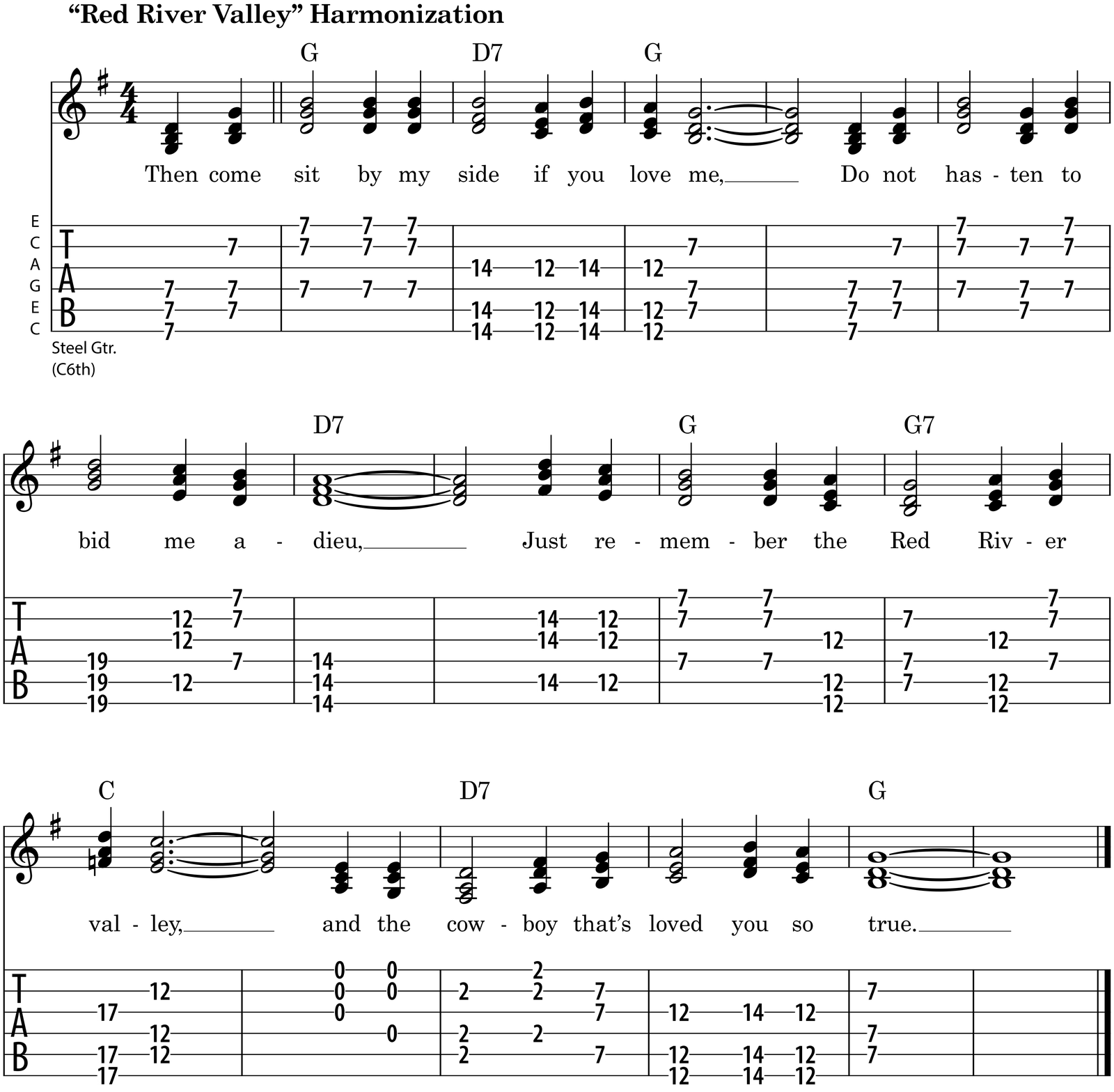
Here is an arrangement of “Red River Valley” created using the harmonizer. As mentioned, this arrangement is not extremely playable due to the large skips, but is a great starting point for finding more accessible 2-part voicings. Interestingly, this sounds like a pedal-steel arrangement with full harmony, and, of course, with pedals there would be no challenging skips.
The Origins of the Harmonizer
The harmonizer's name is loosely based on the medieval concept of the hexachord, a 6-note scale used in early western music that roughly corresponds to a major scale with the seventh tone omitted. So, for the key of C, the scale tones 'C', 'D', 'E', 'F', 'G', and 'A' form such a hexachord. As it happens, these tones form the roots of all the major and minor triads available on the C6th tuning in the key of C: C major, D minor, E minor, F major, G major, and A minor. Early on, I noticed two things:
- Using only these six chords, you can harmonize almost any tune.
- At any fret of the C6th tuning, you can get a major chord in all its inversions and a minor chord in all its inversions. This fact alone explains the power of sixth tunings!
So the 6 building block chords—the ones named above—each exist in 3 inversions for a total of 18 voicings. These are the voicings upon which the system is built.